Nov 25, 2026
ADIPEC 2026 Takeaways: AI Is Everywhere, but Value Shows Up at the Point of Decision
What four days at our ADIPEC 2026 stand taught us: the interest in AI is real, its value shows up...
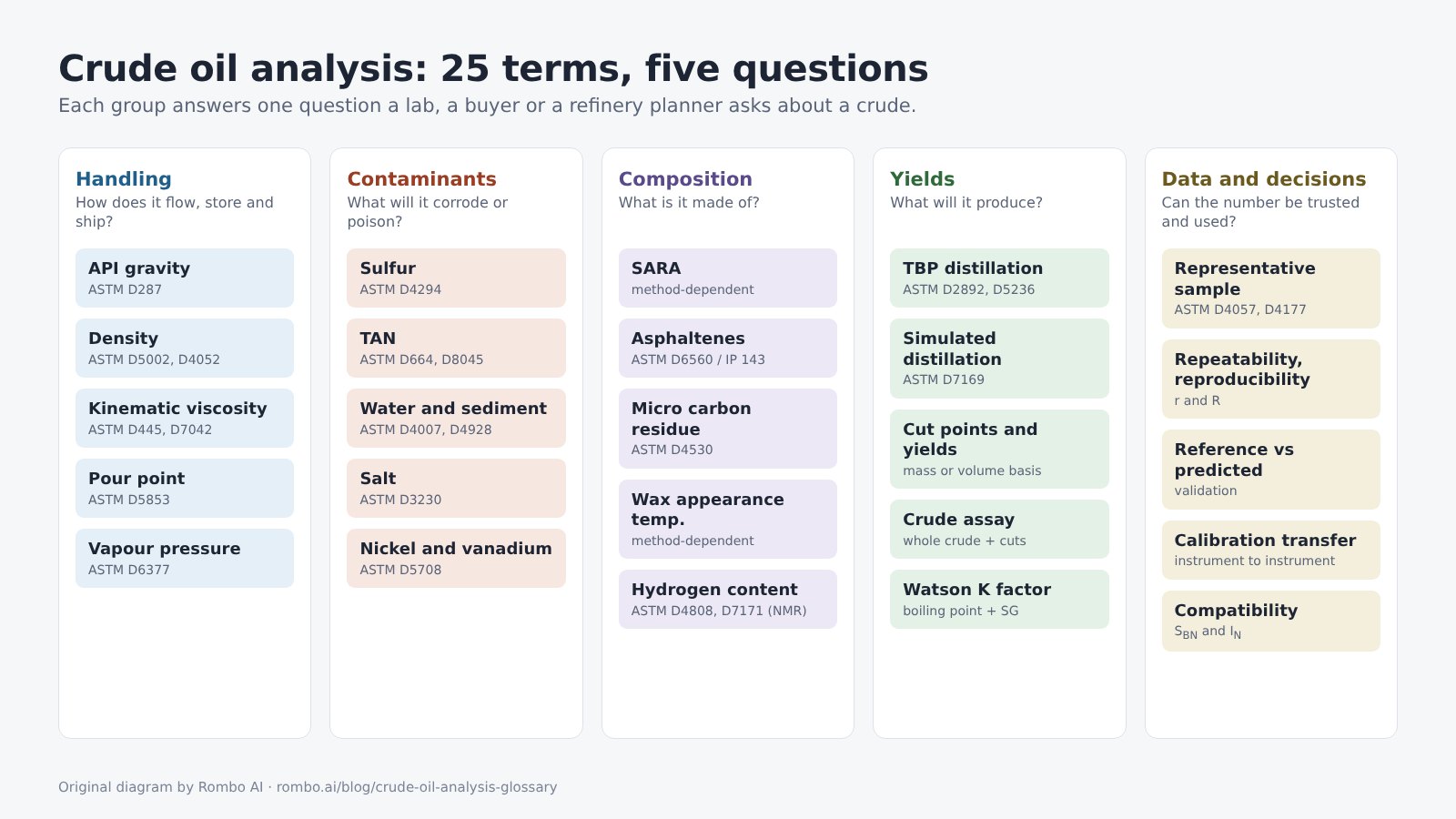
Crude oil reports mix physical properties, contaminants, composition, yields and statistics on one page. New staff, buyers and engineers often know some of the terms and not the others. This glossary defines the 25 that come up most often in a crude oil laboratory, names a common standard method for each and says what the number is used for. For the economics behind these tests, see our guide to crude oil analysis in the refinery.
API gravity. A density scale set by the American Petroleum Institute: °API = 141.5 / SG − 131.5, with specific gravity (SG) at 60 °F. Water is 10 °API; lighter crudes have higher values. It is the first number in most crude descriptions and a pricing reference. Measured with a hydrometer (ASTM D287) or calculated from density.
Density. Mass per unit volume, usually reported in kg/m³ at 15 °C. For crude oil, digital density meters (ASTM D5002, ASTM D4052) are common. Density converts volumes to mass for custody transfer and yield calculations.
Kinematic viscosity. Resistance to flow under gravity, in mm²/s at a stated temperature, by capillary viscometer (ASTM D445) or Stabinger viscometer (ASTM D7042). It drives pumping, pipeline and heat-exchanger design. A value without its temperature cannot be compared.
Pour point. The lowest temperature at which the oil still flows under the test conditions. For crude oil, ASTM D5853 gives two procedures, an upper and a lower pour point, because thermal history changes the result. It matters for storage, pipelines and cold-climate loading.
Vapour pressure. A measure of light ends and of the risk of vapour losses and unsafe tank or transport conditions. ASTM D6377 measures the vapour pressure of crude oil by an expansion method (VPCRx, where x is the vapour-to-liquid ratio); the older Reid vapour pressure (ASTM D323) is still quoted in some contracts.
Sulfur content. Total sulfur by mass, often by X-ray fluorescence (ASTM D4294, which lists crude oil in its scope). Crude below about 0.5% sulfur is usually called sweet, above it sour. Total sulfur sets hydrotreating load and product compliance; it does not say which sulfur compounds are present.
TAN (total acid number). Milligrams of potassium hydroxide needed to neutralise the acids in one gram of oil (mg KOH/g), by potentiometric (ASTM D664) or thermometric (ASTM D8045) titration. High-TAN crudes are reviewed for naphthenic acid corrosion in hot sections. TAN alone does not predict a corrosion rate.
Water and sediment (BS&W). Free and emulsified water plus solids, by centrifuge (ASTM D4007). Dissolved and dispersed water at low levels is measured by Karl Fischer titration, for example coulometric ASTM D4928. Water is paid for at crude prices and affects desalter operation.
Salt content. Chloride salts of sodium, calcium and magnesium, reported in mg/kg or pounds per thousand barrels (PTB). ASTM D3230 estimates them from the conductivity of the oil in a solvent mixture. Salts that pass the desalter can form hydrochloric acid in the crude unit overhead.
Metals (nickel and vanadium). Trace metals, mostly bound in porphyrins and asphaltenes, measured by ICP atomic emission (ASTM D5708) or atomic absorption (ASTM D5863). They deactivate catalysts in conversion units and concentrate in the residue.
SARA. Separation into saturates, aromatics, resins and asphaltenes by solubility and chromatography. Methods differ (clay-gel adsorption, thin-layer chromatography with flame ionisation detection, HPLC), so SARA numbers from different methods are not directly comparable. SARA ratios are used to screen asphaltene stability, with known limits.
Asphaltenes. The fraction that is insoluble in an n-alkane and soluble in toluene. The definition depends on the solvent: ASTM D6560 (also IP 143) measures heptane insolubles, on crude topped to 260 °C, and states precision between 0.5% and 30% by mass. Asphaltenes drive fouling, sludge and blend instability.
Micro carbon residue (MCR). The residue left after the sample is heated under nitrogen (ASTM D4530), the micro-scale counterpart of the Conradson carbon residue. It indicates coke-forming tendency for cokers and catalytic crackers.
Wax appearance temperature (WAT). The temperature at which wax crystals first appear as the oil cools, by cross-polarised microscopy, differential scanning calorimetry or viscometry. It is usually above the pour point and depends on the method and on cooling rate. It sets the risk of wax deposition in pipelines and tanks.
Hydrogen content. Hydrogen as a percentage by mass. It is one of the few properties that low-resolution NMR measures directly, with standardized methods such as ASTM D4808 and D7171. Together with aromatic and aliphatic hydrogen, it describes how hydrogen-rich, and therefore how easy to upgrade, an oil is. Our guide to benchtop NMR in petroleum labs separates what the signal measures from what a model estimates.
TBP distillation. True boiling point distillation with a fractionating column of 14 to 18 theoretical plates at a 5:1 reflux ratio, as in ASTM D2892, up to 400 °C atmospheric equivalent temperature. The heavier part is continued under vacuum (ASTM D5236). It produces physical cuts for further testing, and it takes days of laboratory time.
Simulated distillation (SimDis). A boiling point distribution from gas chromatography. ASTM D7169 covers crude oils and residues up to 720 °C, the elution of n-C100, and quantifies the part that does not elute. It is fast and needs little sample, but it gives no physical cuts.
Cut points and yields. The temperatures that divide the crude into naphtha, kerosene, diesel, vacuum gas oil and residue, and the share of each. Always check whether a yield is on mass or volume basis, and whether it is a potential yield from the assay or the effective yield of a unit.
Crude assay. The full description of a crude: whole-crude properties plus TBP yields and the properties of each cut. Assays feed refinery planning models and crude selection. A basic assay covers whole-crude properties only.
Watson K factor. A characterisation factor that combines average boiling point and specific gravity: K = (Tb)1/3 / SG, with Tb in degrees Rankine. Higher values point to more paraffinic oils, lower values to more naphthenic and aromatic ones. It is a quick input to correlations, not a measurement of composition.
Representative sample. A sample whose composition matches the tank, pipeline or cargo it stands for. Manual sampling (ASTM D4057, API MPMS Chapter 8.1) defines upper, middle and lower spot samples; automatic pipeline sampling follows ASTM D4177. A stratified tank can make one spot sample misleading, as our article on crude oil tank stratification shows.
Repeatability and reproducibility (r and R). Precision statements in each method. Repeatability is the largest expected difference between two results by one operator on the same apparatus; reproducibility, between two laboratories. Both are set so that a larger difference occurs about once in twenty cases. A change smaller than R between two laboratories is not evidence of a different oil.
Reference method and predicted value. The reference method is the standard test that defines the property. A predicted value comes from a secondary method, such as NIR or NMR with a model, calibrated against that reference. It is reliable only within the range and the oil types used for calibration, and only after validation against the reference method with agreed acceptance limits. Our comparison of NIR and NMR for crude oil covers where each fits.
Calibration transfer. Moving a model from one instrument or site to another without rebuilding it. Small differences in hardware, temperature or sample handling can shift predictions, so a transferred model needs checks on the new instrument. Our guide to calibration transfer explains why models break and how labs test them.
Compatibility (SBN and IN). Whether two crudes can be blended without precipitating asphaltenes. In the oil compatibility model, each oil has a solubility blending number (SBN) and an insolubility number (IN); a blend stays stable while its SBN remains above the highest IN of its components. Our guide to crude oil compatibility and asphaltene stability compares the tests.
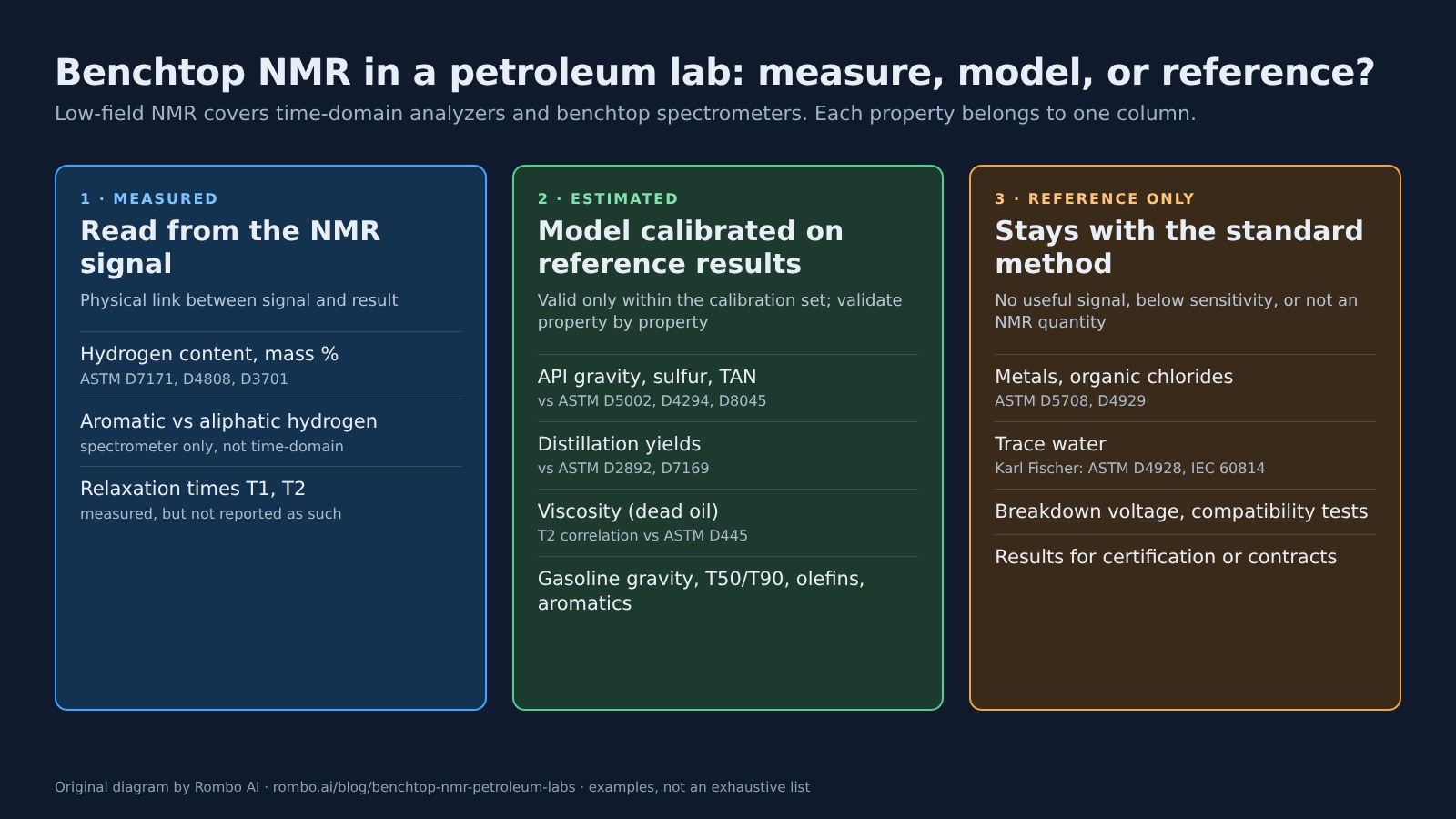
A benchtop NMR scan measures hydrogen content and the split between aromatic and aliphatic hydrogen directly. Properties such as API gravity, sulfur, TAN, distillation yields and viscosity can be estimated from the same scan through a model, as our application note on API gravity, sulfur and TAN explains. Metals, salt, trace water, vapour pressure and compatibility tests stay with their reference methods.
Rombo AI Platform is designed to estimate several of these properties from one benchtop NMR scan, with each property validated against your own ASTM methods and acceptance metrics agreed before the pilot. The crude oil monitoring use case shows the workflow. To check which properties are realistic for your crudes, start with a feasibility review. To receive new guides like this one, subscribe to the Rombo AI newsletter at the bottom of this page.
Both describe the same property. Density is mass per volume, usually in kg/m³ at 15 °C; API gravity is an inverted scale derived from specific gravity at 60 °F, so a lighter oil has a higher API value. Laboratories often measure density and calculate API gravity.
No. TBP distillation separates the crude into physical cuts in a fractionating column; simulated distillation estimates the boiling point distribution by gas chromatography. SimDis is faster and needs far less sample, but it produces no cuts for further testing, and the two curves do not match exactly.
Its sulfur content. Crude with less than about 0.5% sulfur by mass is usually called sweet, above that sour; the cut-off is a market convention, not a standard. Some contracts also look at hydrogen sulfide and mercaptans, which total sulfur does not separate.
Posted by: Martina [Marketing Specialist, Rombo AI]
BOOK A DEMO
Share your analytical challenge with our team. We will assess technical fit, data or sample requirements, and the fastest path to a focused pilot.
Book a demo