Nov 25, 2026
Crude Oil Analysis Glossary: 25 Terms Every Lab Manager Should Know
A short reference for crude oil laboratories: 25 terms from API gravity and TAN to SARA, TBP dist...
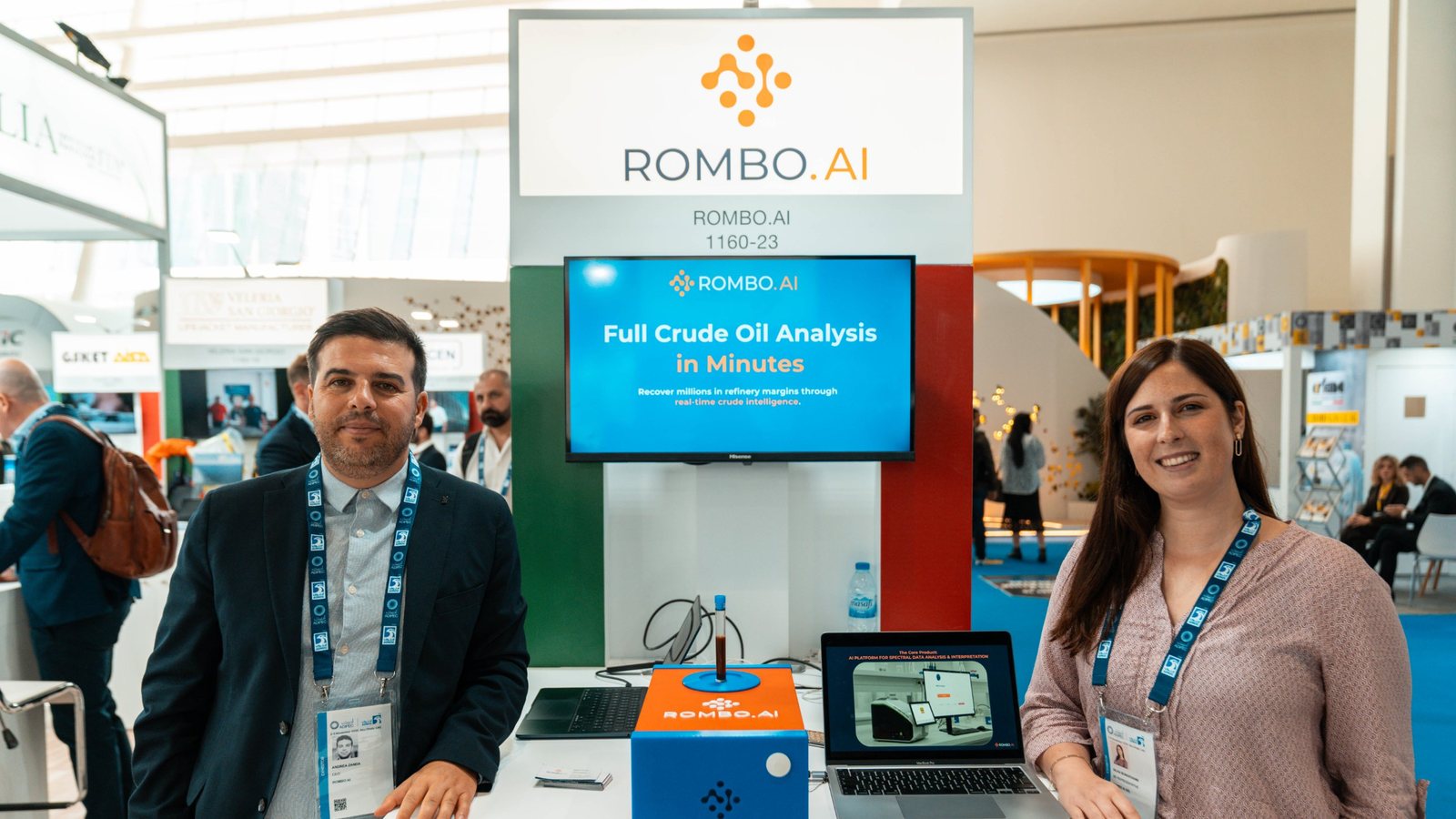
I came back from ADIPEC in Abu Dhabi with a full notebook, jet lag and a clear impression: the oil and gas industry is ready to take AI seriously. The question now is how to make it count.
The interest in AI-driven solutions was impossible to miss. The exhibition had an expanded AI Zone, co-hosted by AIQ, the energy AI company owned by Presight and ADNOC, and it was one of the busiest areas of the show. National oil companies, refiners, service companies and technology providers were all exploring how AI can support their operations, from digital twins to predictive maintenance to laboratory analysis.
There is traction and there is appetite. The conversations have moved past “should we use AI?” to “where does it create real value?” The chair of the ADIPEC technical conference framed it the same way before the show: the industry has moved from why to where and how.
Our own conversations at the stand over the four days pointed in the same direction. Upstream was everywhere: many of the people we met wanted faster crude characterization, closer to the well, with questions on PVT behaviour and on how quickly results can reach the people making production decisions. NMR is already part of the toolkit in some of the labs we spoke with, and the request we heard there was for AI models on top of it. That is the layer our platform adds: it turns NMR spectra into property predictions that are checked against the lab’s own reference methods. Interest also came from service companies, system integrators and instrument makers who want to bring an AI layer to their own clients and equipment.
Accenture Strategy CEO Muqsit Ashraf captured that shift well in a piece written for ADIPEC. Citing Accenture’s Pulse of Change research, he notes that 75% of C-suite leaders are increasing their AI investment, yet only about a quarter report widespread, sustained business value. He calls it a readiness gap, not an ambition gap. One sentence stayed with me: AI creates advantage “at the point of decision”, not at the point of deployment.
He also uses an analogy that fits our industry well. When electricity first arrived in factories, many manufacturers simply used electric motors to drive the old shafts and belts, and changed nothing else. The real gains came later, when the whole plant was redesigned around what electricity made possible. His point is that AI is posing the same test today.
In oil and gas, the point of decision is very concrete. Is this crude what the assay says it is? How will this feedstock behave in the unit? Is this product on spec, or do we hold the tank? Is that change in composition an early warning, or just noise?
These decisions happen every day in refinery and production labs. They are often invisible, but they feed directly into margins, safety and compliance; we followed them unit by unit in why crude oil analysis matters at every stage of the refinery. Some of them deserve a guide of their own, such as whether two crudes can be blended or what a stratified tank means for the crude unit.
Several people told us their labs are overloaded with analyses and characterizations, and that the expertise to read them is concentrated in a few senior people. An AI tool that produces a nice report but does not speed up or improve one of these decisions adds little. One that turns an analytical measurement into an answer operations can trust changes how a plant runs. Our crude oil monitoring use case shows what that workflow looks like in practice.
Building AI that works for oil and gas needs real, up-to-date operational data, and getting it, especially from the majors, is hard. There are good reasons for that: this data is sensitive, often confidential and strategically valuable. It is shared only when there is a solid relationship, clear guarantees on how it will be protected and used, and a concrete benefit for whoever shares it.
Trust also shapes how teams look at the technology itself. The questions we got at the stand were about accuracy, concrete use cases and how our models reach their results. Several people also wanted to understand how AI fits alongside certified laboratory testing. Our answer is that it complements testing rather than replacing it: a model is only as credible as its validation against the lab’s ASTM reference methods, and the reference methods remain the reference. Engineers and operators also need the confidence and the skills to challenge AI outputs, which is why we keep a human in the loop. Without trust there is no data, and without data there is no AI that holds up in the field.
These are the questions we will keep working on at Rombo AI, as we bring NMR and AI closer to the decisions that lab results feed. Earlier this year we asked what it takes for AI to succeed in downstream refining; ADIPEC gave us plenty to add.
Thank you to everyone who stopped by and challenged us with tough questions. Let’s keep the conversation going: write to contact@rombo.ai with questions, comments or insights on our products. If you want to see what NMR and AI can do on your own crudes and reference methods, start with a feasibility review. To receive articles like this one, subscribe to the Rombo AI newsletter at the bottom of this page.
Posted by
Silvia Bongiovanni — Marketing & Communications
BOOK A DEMO
Share your analytical challenge with our team. We will assess technical fit, data or sample requirements, and the fastest path to a focused pilot.
Book a demo