Nov 11, 2026
Crude Oil Tank Stratification: Why It Happens, How to Detect It and What It Means for the CDU
Why a crude tank can stop being one sample, how stratification differs from incompatibility and s...
Two crude oils can each be perfectly stable and still form a blend that cannot keep its asphaltenes in solution. The result is sludge in tanks, upsets in the desalter and fouling in the preheat train and furnace tubes. This guide explains what crude oil compatibility means, how the oil compatibility model turns two lab tests into a blending rule, what the standard stability tests report and where they stop, and which predictive approaches exist, including spectroscopy with machine learning.
Last reviewed: 16 November 2026.
Asphaltenes are the heaviest, most aromatic and most polar fraction of crude oil, defined by solubility: insoluble in n-heptane, soluble in toluene. In a stable crude they stay dispersed because the rest of the oil, its aromatics and resins, keeps them in solution. Blending changes that balance. Adding a paraffinic, light crude to an asphaltenic one lowers the solvency of the mixture, and if it falls far enough, the asphaltenes flocculate.
Two words are often used loosely. Stability describes one oil: how much margin its asphaltenes have before they precipitate. Compatibility describes a blend: whether the oils can be mixed in a given proportion without precipitation. A refinery cares about the second, because crude slates change and every tank and blend header mixes oils that were never tested together.
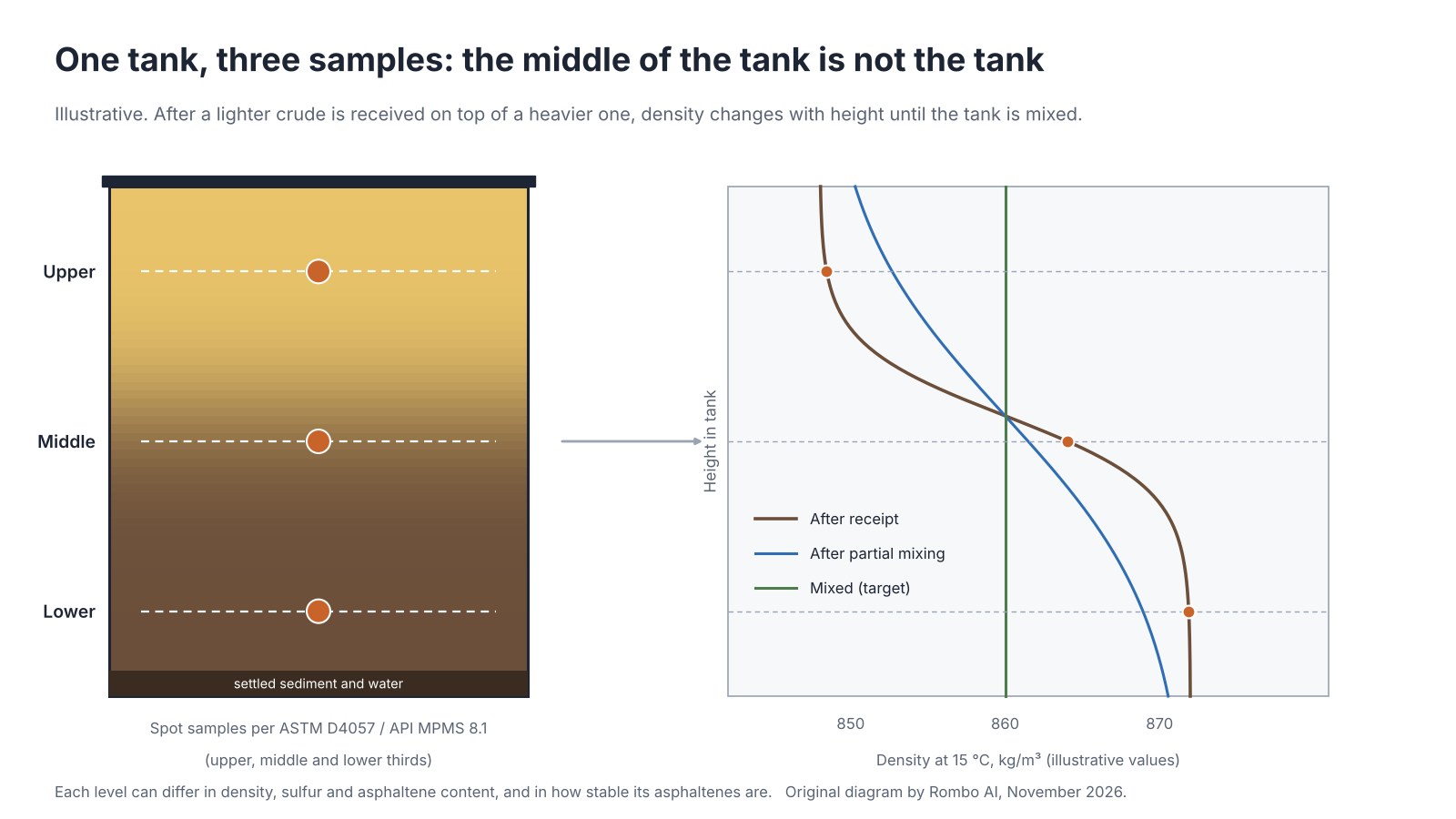
Incompatibility also differs from the physical layering of a tank. Our guide to crude oil tank stratification separates three problems that look alike in a tank: stratification, incompatibility and sediment. A mixer cures the first; it does not cure the second.
The consequences show up downstream. Wiehe, Kennedy and Dickakian reported that heat exchanger fouling comes not only from incompatible blends but also from nearly incompatible ones, because asphaltenes adsorb more readily on hot metal as the blend approaches the precipitation point. In a refinery example of the original model, choosing the right blending order mitigated coking of vacuum furnace tubes, according to the paper’s abstract.
The oil compatibility model of Wiehe and Kennedy, published in Energy & Fuels in 2000 and covered by US patent 5,871,634, rests on two ideas: asphaltenes precipitate at a fixed solvency, expressed on a toluene–n-heptane scale, and the solvency of a mixture is the volume average of its components. Each oil gets two numbers on a 0–100 scale where n-heptane is 0 and toluene is 100:
Both come from two titrations, described in a later paper by Wiehe and co-authors. The heptane dilution test finds the largest volume of n-heptane that can be added to the oil before asphaltenes appear. The toluene equivalence test finds the smallest percentage of toluene in a toluene–heptane mixture that keeps them dissolved. Precipitation is detected under a microscope. Two equations convert the two results into SBN and IN.
The blending rule follows directly. For a blend with volume fractions vi:
Two refinements matter in practice. First, order of addition: the patent’s claims call for combining oils in order of decreasing SBN, so that the mixture never passes through an incompatible proportion on its way to the final blend. Second, margin: in a related ExxonMobil patent, low fouling requires the blend’s SBN to exceed 1.4 times the highest IN, and the 2001 paper places nearly incompatible blends at a ratio between 1.0 and 1.4.
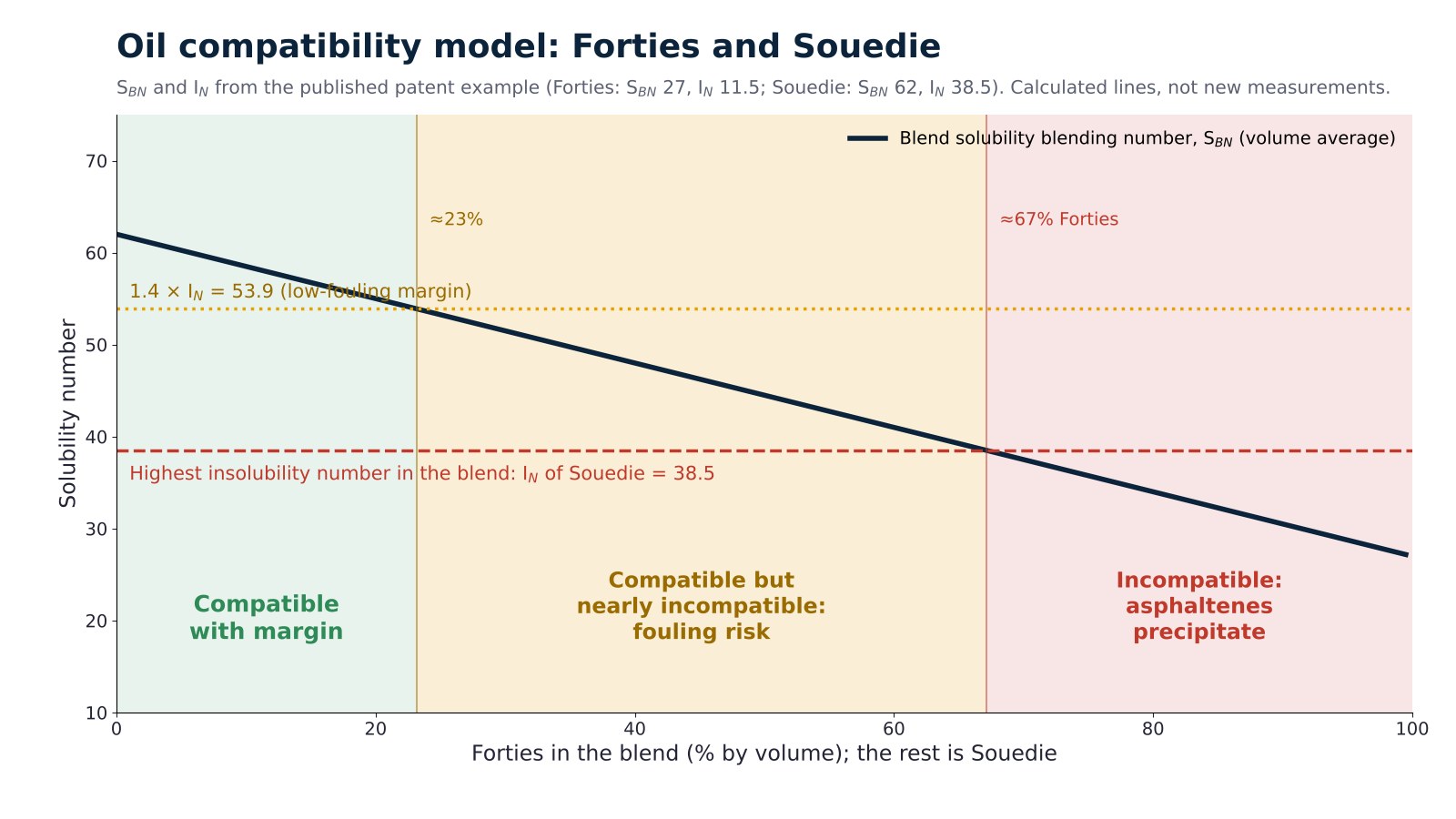
The ExxonMobil patent gives values for two crudes: Forties, from the North Sea (SBN 27, IN 11.5), and Souedie, from Syria (SBN 62, IN 38.5). The highest IN in any blend containing Souedie is therefore 38.5.
With x as the volume fraction of Forties, the blend’s SBN is 27x + 62(1 − x). The chart at the top of this guide plots that line against the two limits:
| Forties in blend | Blend SBN | SBN / highest IN | Reading |
|---|---|---|---|
| 10% | 58.5 | 1.52 | Compatible, above the 1.4 margin |
| 30% | 51.5 | 1.34 | Compatible but nearly incompatible |
| 50% | 44.5 | 1.16 | Compatible but nearly incompatible |
| 70% | 37.5 | 0.97 | Incompatible |
The model puts the limit at about 67% Forties. The patent reports precipitation above about 69% Forties and the highest fouling at 75%: close to the calculation, which is the point of the model.
Order of addition follows from the same line. Pumping Souedie into a tank that already holds Forties starts at the right-hand end of the chart: the first portions of Souedie meet a mixture with an SBN near 27, well below 38.5, and their asphaltenes can precipitate even if the final 50/50 blend would be compatible. Adding Forties to Souedie, in order of decreasing SBN, moves from the left and stays above the limit until 67%. In a tank, the heel left from the previous crude is the first component.
Several ASTM methods measure asphaltene stability, and their scopes differ more than their titles suggest. The summaries below paraphrase the scope statements on the ASTM store pages.
| Test | What it reports | Samples in scope | Use for crude blending |
|---|---|---|---|
| ASTM D7157 | Intrinsic stability as an S-value, with the stability of the oil medium (So) and the solvency requirement of the asphaltenes (Sa); automated titration with optical detection | Residues, heavy fuel oils and crude oils with at least 0.5% asphaltenes by mass | Yes, for crudes with enough asphaltenes |
| ASTM D7112 | Stability and compatibility parameters, including a stability reserve; titration with optical detection | Residues, fuel oils and crude oils with at least 0.05% asphaltenes; not oils already flocculated | Yes, including low-asphaltene crudes |
| ASTM D8253 | Asphaltene solvency properties that give solubility parameters for stability, compatibility and fouling; manual microscopy | Crude oil, condensate, bitumen and blends | Yes; like the titrations above, it gives solubility parameters |
| ASTM D7060 | Maximum flocculation ratio and peptizing power of the asphaltenes | Residues and residual fuel oils with at least 1% asphaltenes; crude oil not named | Outside the stated scope |
| ASTM D4740 | Spot rating of cleanliness and compatibility with a blend stock | Residual fuel oils | No |
| ASTM D7061 | Separability number by optical scanning | Heavy fuel oils and their components; it does not predict compatibility before mixing | No |
| SARA and CII | Ratio of saturates and asphaltenes to aromatics and resins | Any oil that can be fractionated | Screening only (see below) |
Two practical points follow. A test that gives one stability number for the sample in the cell has to be repeated for each blend ratio, while solubility parameters measured per oil, such as SBN and IN, can be combined with a mixing rule. And every one of these tests measures oil in a lab vessel: none says how a tank will mix.
Different methods express the onset of precipitation on different scales and with different detection: a microscope, an optical sensor, a spot on filter paper. Guzmán and co-authors, testing Mexican crudes from API 10 to 52 with SARA-based indices, the oil compatibility model, spot tests, S-value and a static column test, found that the results were not uniform, and advised using more than one method and taking precautions whenever any of them flags a sample. A KBC article makes a related point: onsets measured in different units do not correlate with asphaltene content, and averaging them is unreliable.
The colloidal instability index is the most common shortcut. Computed from a SARA analysis as (saturates + asphaltenes) / (aromatics + resins), it is usually read as stable below 0.7 and unstable above 0.9, as summarized in a 2023 study in Scientific Reports. Several studies question it. Xiong and co-authors found CII results on five crudes that differed greatly from field observations. In a 2024 conference paper covering 68 oils with known refinery behavior, CII classified about half correctly. Saboor and co-authors add that SARA results themselves depend on the separation technique. An older comparison against field deposition data by Asomaning found CII and titration more predictive than a spot test or the asphaltene-to-resin ratio, and found that most tests struggle with low-asphaltene oils.
The practical lesson: agree on one reference method that fits the crude slate, use it consistently, and confirm flagged or borderline results with a second method rather than averaging them.
Testing every crude pair at every ratio is slow, so refineries and their suppliers use models. They fall into four groups.
Mixing rules on measured parameters. The oil compatibility model is the clearest case: test each crude once, then calculate any blend and any order. Its limit is the test itself, which must be repeated for each new crude and cargo.
Correlations from bulk composition. CII and similar SARA indices need no titration, but as shown above they misclassify a substantial share of oils.
Thermodynamic and vendor models. KBC describes an equation-of-state approach in its simulation software that needs a crude assay and at least one measured onset. Process-chemical and service companies offer blend-screening programs: Intertek describes combining NIR fingerprinting, microscopy and a blending algorithm, and Baker Hughes describes a browser-based model of blend stability. These descriptions are the vendors’ own; the methods behind them are not always published.
Spectroscopy with machine learning. If a spectrum carries information about the aromatic and aliphatic balance that keeps asphaltenes in solution, a model can learn the link to measured stability parameters. Published work supports this, on limited sample sets:
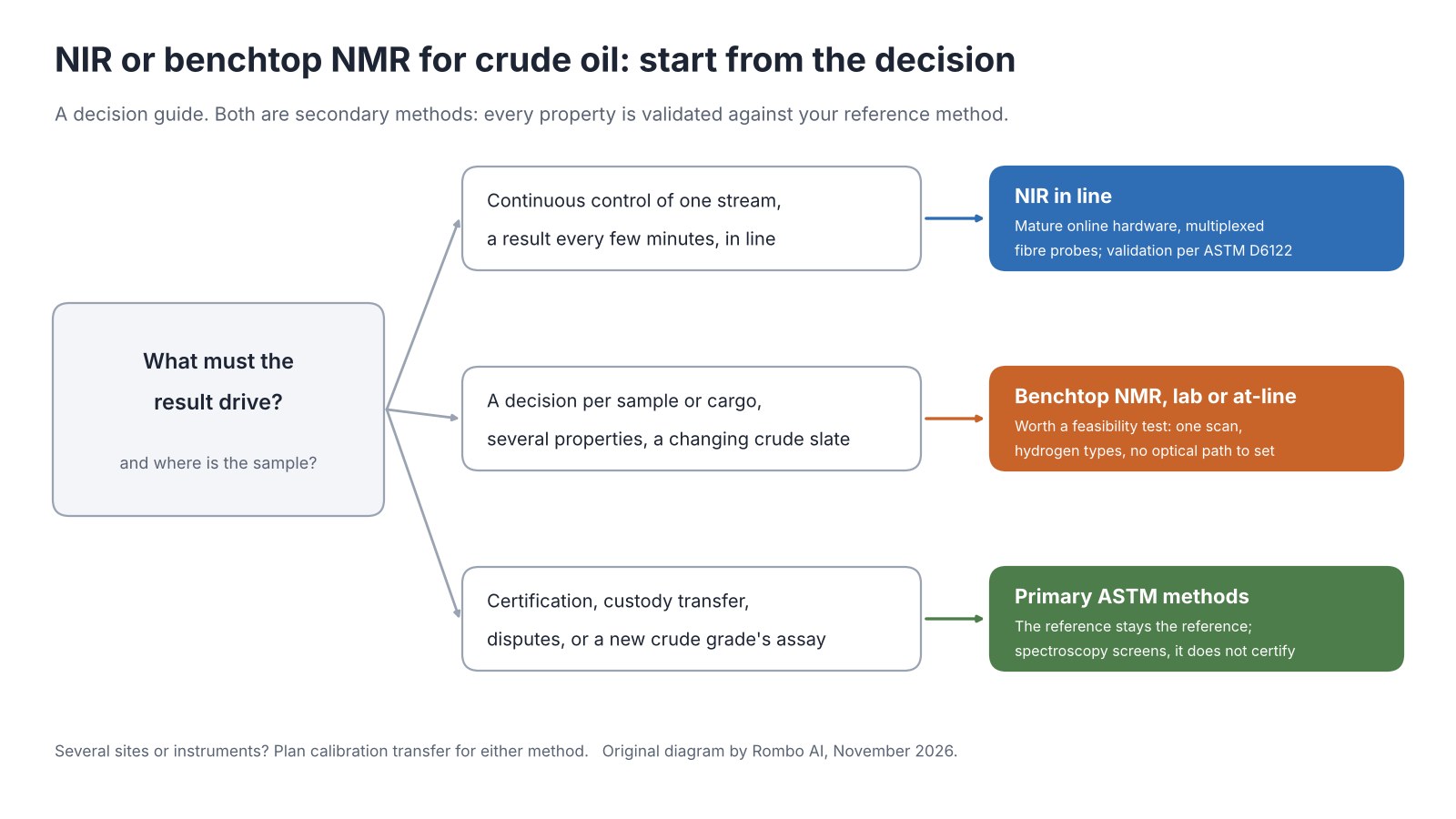
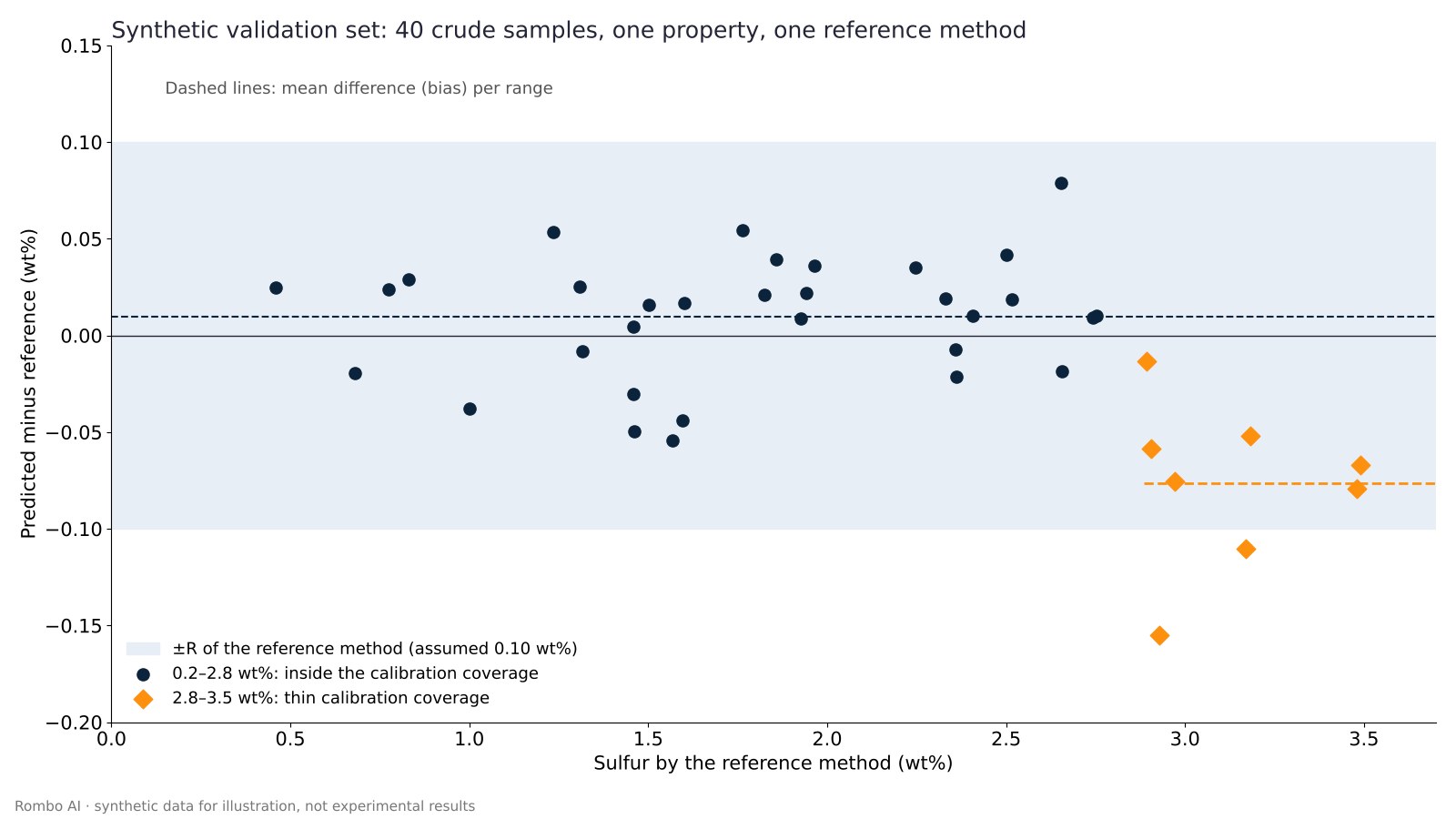
These studies show that the information is in the spectrum. They do not show that a given model works on another refinery’s slate. The validation questions are the same as for any spectroscopic property model: independent samples, acceptance limits tied to the reference method’s precision and checks on crudes outside the calibration range, as set out in our guide to validating a property model against ASTM methods. Our comparison of NIR and NMR for crude oil analysis covers where each spectroscopy fits.
Rombo AI builds property models on benchtop NMR spectra of crude oil. A proton spectrum records how hydrogen is distributed between aromatic and aliphatic environments, which relates to an oil’s ability to keep asphaltenes in solution. For compatibility, that means:
This complements the lab, it does not replace it. If your refinery processes a changing slate, the crude oil monitoring use case shows the workflow, and our feasibility review starts from your crudes and your reference methods. Where the crude is sampled and what each result decides is covered in why crude oil analysis matters at every stage of the refinery. To receive new guides like this one, subscribe to the Rombo AI newsletter at the bottom of this page.
Stability describes one oil: how much margin its asphaltenes have before they precipitate. Compatibility describes a blend: whether two or more oils can be mixed in a given proportion without precipitation. Two stable crudes can be incompatible.
It depends on the slate. ASTM D7157 covers crude oils with at least 0.5% asphaltenes, D7112 reaches down to 0.05%, and D8253 and the titrations of the oil compatibility model give solubility parameters that can be applied to any blend ratio. Use one reference method consistently and confirm flagged or borderline results with a second method rather than averaging them.
Because the mixture passes through every intermediate proportion. Adding a high-solvency crude to a low-solvency one can briefly create an incompatible mixture even when the final blend is compatible. Blending in order of decreasing SBN avoids this.
No. CII is quick to compute from SARA data, but published studies report frequent misclassification and SARA results vary with the separation method. Use it as a screen and confirm borderline cases with a stability test.
Posted by: Martina [Marketing Specialist, Rombo AI]
BOOK A DEMO
Share your analytical challenge with our team. We will assess technical fit, data or sample requirements, and the fastest path to a focused pilot.
Book a demo