Sep 20, 2024
Low-Field NMR for Crude Oil Analysis: Harnessing Machine Learning for Predicting Properties
Low-field NMR and machine learning can predict several crude oil properties, including distillati...
·

Updated 27 October 2026: This introduction was first published in 2023. We have qualified the statements on cost, portability and real-time monitoring, replaced an off-topic section on predictive maintenance with one on validation, and added sources. For how we apply low-field NMR and machine learning to crude oil today, with each property validated against your reference method, see the crude oil monitoring use case.
Nuclear Magnetic Resonance (NMR) is an analytical technique used to determine the molecular structure and composition of substances. Low-field NMR here means benchtop spectrometers: they use permanent magnets, need no liquid helium, and operate at proton frequencies of roughly 40 to 125 MHz depending on the model, against 400 MHz and above for the superconducting instruments common in research laboratories (overview of benchtop NMR).
The principle is the same at any field. Nuclei with a magnetic moment, such as hydrogen, align with an external magnetic field. A radiofrequency pulse tips them out of alignment, and as they precess and relax they induce a small signal in a receiver coil. Fourier transformation turns that signal into a spectrum, in which each peak’s position (the chemical shift) reflects the chemical environment of the nuclei. Under quantitative acquisition conditions, a signal’s integrated area is proportional to the number of nuclei that produced it, which is the basis of quantitative NMR (qNMR).
For hydrocarbons such as crude oil or refined products, a proton spectrum records how hydrogen is distributed between aromatic, olefinic and aliphatic environments, without consuming the sample. Most properties a laboratory reports, such as density or sulfur content, are not read directly from that spectrum. They are predicted by a model calibrated against reference measurements, as described below.
Advantages for industrial laboratories, particularly in oil and energy:
Limits to plan for:
Machine learning turns a low-field spectrum into property estimates. A model learns, from samples measured both by NMR and by the reference method, which spectral patterns go with which property values. It works with the overlap described above rather than requiring every signal to be resolved.
Models such as partial least squares (PLS) regression and convolutional neural networks (CNN) can be trained on NMR spectra to predict physical and chemical properties of crude oil, such as density, viscosity or sulfur content. A 2020 benchtop NMR study used 60 MHz proton spectra and PLS models on more than 170 crude samples to estimate API gravity, sulfur, total acid number (TAN) and distillation yields.
These are predictions, not direct readings. Sulfur atoms give no proton signal, for example, so a model estimates sulfur from correlations with the hydrocarbon structure, and those correlations hold only as far as the calibration samples represent your crudes. Our application note on API gravity, sulfur and TAN explains what this means for each property.
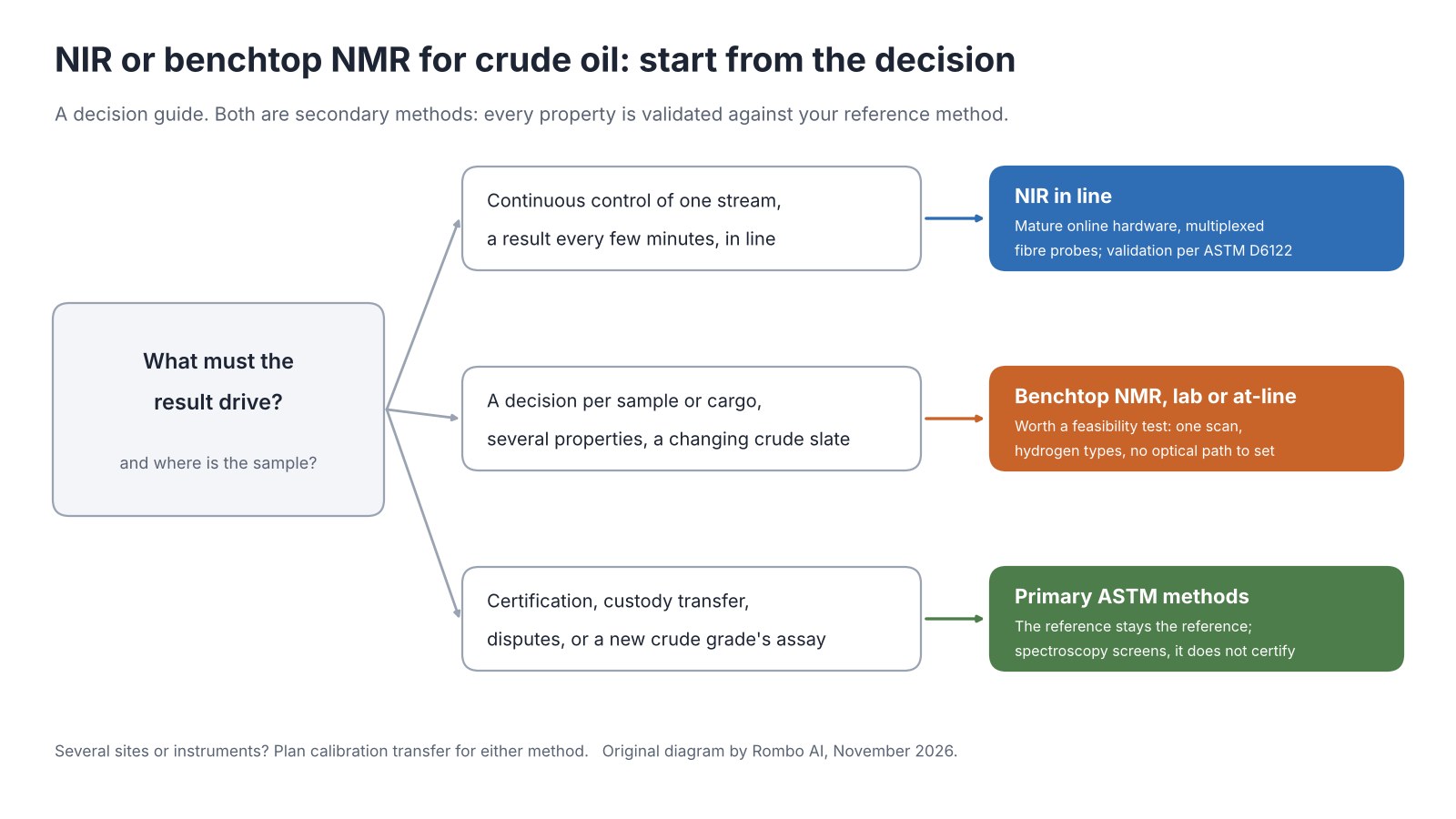
Because acquisition is fast, a validated model can let a laboratory check some properties more often than the full reference test allows, for example at crude receipt or before a blend. Whether that becomes at-line or online monitoring depends on the sampling setup. A comprehensive crude assay still takes longer, because it combines fractionation, several instruments, queues and review, as our guide to crude oil analysis in the refinery describes.
Automated processing (phasing, baseline correction, referencing) and a fixed prediction pipeline reduce manual spectrum interpretation and the variation between operators. They do not remove the chemist: someone decides which results to accept, checks samples unlike anything in the calibration set, and keeps the reference method as the reference.
A property model is only as useful as its validation. Each property should be compared with the reference method on independent samples, with acceptance limits agreed in advance. When the model moves to another spectrometer, or after a service, line shape, referencing and gain can change, and the model needs to be checked again. Our guide to calibration transfer explains the options and how to validate them. The same approach applies to insulating oil, covered in our transformer oil testing guide.
To check whether your samples and properties are a good fit for NMR-based prediction, start with a feasibility review.
Posted by
Andrea Zanda — CEO & Co-founder
BOOK A DEMO
Share your analytical challenge with our team. We will assess technical fit, data or sample requirements, and the fastest path to a focused pilot.
Book a demo