Oct 19, 2026
Transformer Oil Testing: Which Properties Matter, How They Are Measured, and Where NMR Fits
Which insulating oil properties utility labs test, which IEC and ASTM methods measure them, what ...
·
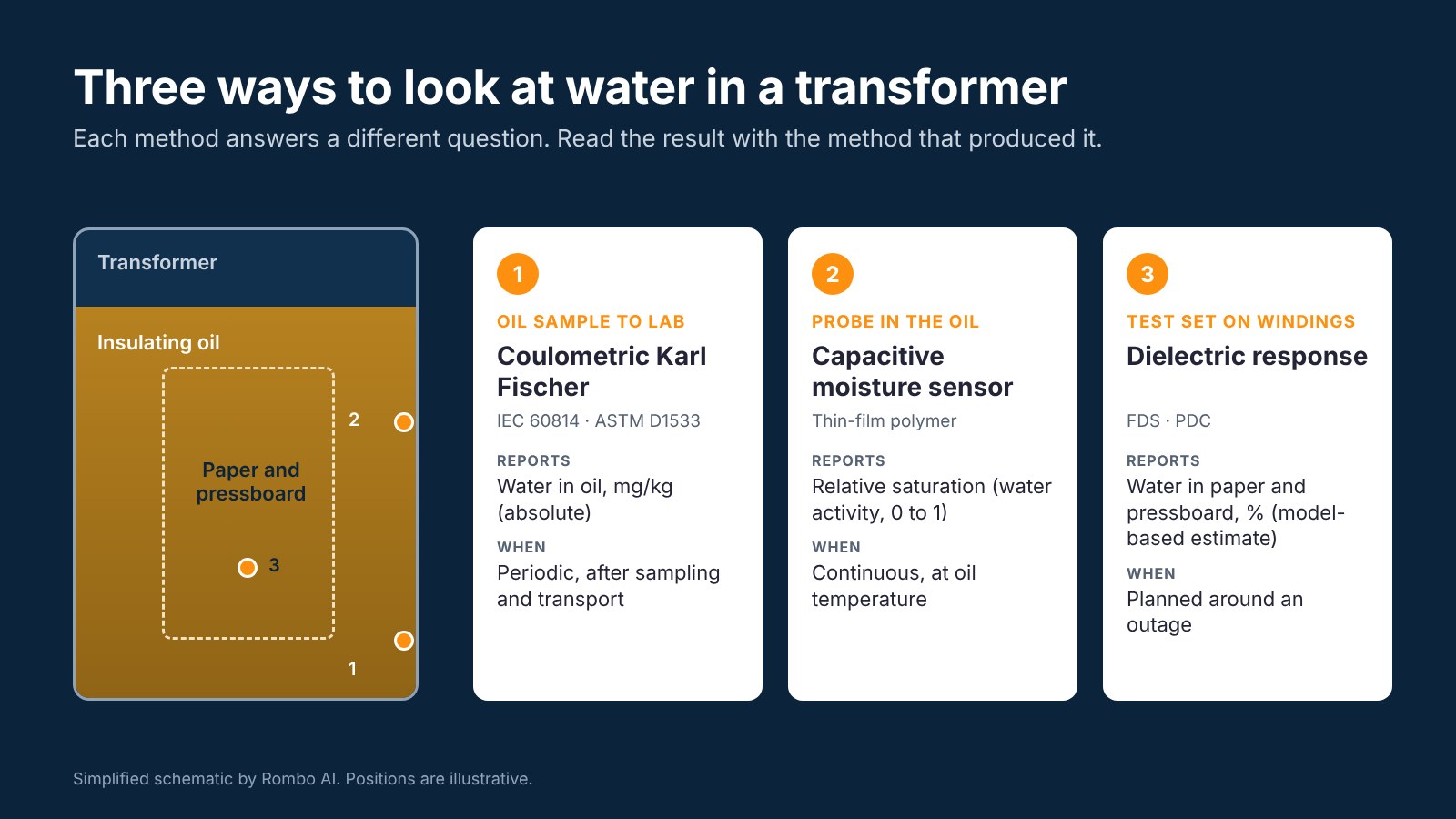
Water is one of the transformer oil properties that utility labs track most routinely. The titration itself is mature and sensitive. The difficulty is everything around it: getting a representative sample to the lab, choosing the right Karl Fischer variant, and interpreting a number that depends on temperature and on the age of the oil.
Water degrades the electrical properties of an insulating liquid. ASTM D1533 notes that excessive water can make a liquid unsuitable for some applications because it lowers properties such as dielectric breakdown voltage. Laboratory work on transformer oil shows the same direction: breakdown voltage and resistivity rise as water content falls.
The oil is only part of the picture. Water is shared between the oil and the cellulose insulation (paper and pressboard), and it moves between them as the transformer heats and cools. Oil moisture is therefore a window on the solid insulation, not a direct measurement of it. Researchers at the University of Stuttgart found that estimating paper moisture from oil moisture with equilibrium diagrams not adapted to the material and its aging state gives unreliable results, partly because equilibrium is rarely reached in service.
What it measures. IEC 60814 (Insulating liquids – Oil-impregnated paper and pressboard – Determination of water by automatic coulometric Karl Fischer titration) and ASTM D1533 cover the same principle. Iodine is generated electrochemically and reacts with water in the sample; the charge needed to reach the endpoint gives the amount of water. ASTM D1533 cites a typical detection limit of about 10 µg of water and applies to oil below 100% relative saturation.
Direct injection or oven. In direct injection, the oil goes straight into the titration cell. In the oven (evaporation) variant, the sample is heated and the released water is carried into the cell by a dry gas. The oven keeps the matrix out of the cell, which is why it is common for petroleum products with interfering additives and necessary for paper and pressboard.
For transformer oil the choice matters. In a study by Koch, Tenbohlen, Blennow and Höhlein (ISH 2007), coulometric titration with direct injection gave the most reliable results for oil. The oven method gave the lowest values on new oil and was not recommended for aged oil, where persistent drift suggested side reactions with aging products.
Where results scatter. The same study ran a round robin with eight laboratories from four European countries. Agreement on oil was reasonable only for the wet sample. For dry oils, a standard deviation of 20% within a single laboratory was not unusual. The authors also point to the sample itself: moisture can enter in humid weather, from bottles that are not dry, and during long transport. They advise testing within about one week, depending on how tight the container is.
Temperature is the last piece. A thesis on moisture diagnosis in transformer insulation (Chalmers, 2006) found that oil-based and dielectric estimates agreed when the correct temperature, the transformer’s service temperature, was used for the Karl Fischer results. Record the oil temperature at sampling with every Karl Fischer result. It is the same principle we described for crude oil sampling in refineries: a precise measurement cannot correct an unrepresentative sample.
| Method | What it reports | Where and when | Strengths | Limits |
|---|---|---|---|---|
| Coulometric KF, direct injection (IEC 60814, ASTM D1533) | Water in oil, mg/kg (absolute) | Lab, on a periodic sample | Reference method; high sensitivity | Sampling and transport errors; scatter on dry oils; a snapshot at one temperature |
| KF with oven evaporation | Water in oil or in solids, mg/kg or % | Lab | Keeps interfering matrices out of the cell; needed for paper | Not recommended for aged oil (Koch et al.); result depends on oven temperature |
| Online capacitive sensor | Relative saturation, or water activity from 0 to 1 | On the transformer, continuous | Trends and temperature cycles without sampling | ppm needs oil-specific solubility coefficients; not directly comparable with KF ppm |
| Dielectric response (FDS, PDC) | Estimated water in paper and pressboard, % | Test set on the windings, typically during an outage | Targets the solid insulation directly | Model-based; oil conductivity affects interpretation |
Online capacitive sensors use a thin polymer film whose capacitance changes with water activity. They report how close the oil is to saturation, on a scale from 0 (dry) to 1 (saturated). One vendor specifies an accuracy of up to ±0.01 water activity. Converting the reading to ppm requires solubility coefficients for the specific oil, which sensor vendors publish for common mineral transformer oils. CIGRE Working Group D1.52 examined the limits and uncertainty of that conversion in Technical Brochure 741 (2018). It also reported that plotting relative saturation against temperature is an effective way to indicate how wet the insulation is.
Dielectric response methods (frequency domain spectroscopy, FDS, and polarization and depolarization currents, PDC) estimate water in the solid insulation from its electrical response. Koch and colleagues reported that conductive aging products in the oil can shift the estimate unless the analysis compensates for them.
Koch et al. give a clear illustration. In new oil at 40 °C, 40 ppm of water corresponds to a relative saturation of 33%, and the expected breakdown voltage in their example is 58 kV. In aged oil, the same 40 ppm corresponds to only 16% relative saturation, and the breakdown voltage is unexpectedly high at 69 kV.
Water solubility changes as oil ages. In this example the aged oil could hold more dissolved water, so the same absolute concentration sat further from saturation. Two practical consequences follow:
Rombo AI builds property models on benchtop NMR spectra and benchmarks each property against the customer’s reference method. Our foundation model is pre-trained on NMR spectra and is designed to need fewer reference samples per property than a model trained from scratch.
For water, the reference stays IEC 60814. Trace water in dry oil is a demanding target for any indirect method, so we treat it as a question to answer with your data, not as an assumption. The useful starting point is the same discipline described above: paired samples, a documented sampling temperature, duplicate Karl Fischer analyses, and acceptance metrics agreed before a pilot begins. NMR signals are quantitative when acquisition is controlled, as our guide to qNMR purity, calibration and accuracy explains. Predicting a property such as water from a spectrum is a further step, and that step is what a validation has to test.
The transformer oil monitoring use case summarizes how an oil-condition workflow can be structured. To test it on your own samples and reference methods, start with a feasibility review.
It depends on the equipment, its voltage class and the oil temperature at sampling. Use the maintenance guidance your organization applies, such as IEC 60422, and judge each result against the trend for that transformer.
Not directly. A sensor reports relative saturation continuously, while Karl Fischer gives an absolute concentration on a sample. They are complementary: the sensor shows behavior over temperature cycles, the titration anchors the absolute value.
Not as a replacement for IEC 60814 at the low levels found in dry oil. Whether an NMR-based model can predict water reliably for a given oil and range must be shown on paired samples against Karl Fischer results.
Posted by: Martina [Marketing Specialist, Rombo AI]
BOOK A DEMO
Share your analytical challenge with our team. We will assess technical fit, data or sample requirements, and the fastest path to a focused pilot.
Book a demo