Aug 24, 2026
How Spectral Matching and Library Search Work
Spectral matching turns an unknown spectrum into a ranked hit list—but a high score is not automa...
·

Nuclear magnetic resonance and mass spectrometry are often presented as competing identification methods. That framing is misleading because their signals arise from different molecular properties.
IUPAC defines NMR spectroscopy as measuring the response of magnetic nuclei in a magnetic field to electromagnetic radiation. For small organic molecules, the resulting chemical shifts, signal integrals, multiplicities, and correlations describe the environments of nuclei and their relationships to one another. NMR therefore works from the inside of the molecular structure outward.
IUPAC defines mass spectrometry as forming gas-phase ions, with or without fragmentation, and characterizing them by mass-to-charge ratio and relative abundance. MS works from ion mass, isotope composition, adduct behavior, and fragments toward a molecular formula or candidate structure. The exact neutral mass is not observed directly in every experiment; the analyst must identify the ion species and charge before inferring it.
This difference explains why the same unknown can look decisive by one method and ambiguous by the other. Two constitutional isomers can have the same molecular formula and exact mass but different NMR connectivities. Conversely, a trace analyte may be easy to detect by LC-MS yet remain below the practical concentration needed for a useful NMR spectrum.
NMR is strongest when the question is not merely “Which formula fits?” but “How are the atoms connected?” A routine small-molecule investigation may combine several layers of evidence:
NMR acquisition is generally non-destructive: subject to sample stability, solvent choice, and laboratory handling, material can often be recovered after measurement. The same spectrum can also support relative quantification because integrated signal area relates to the number of contributing nuclei under suitable acquisition conditions. A review of combined NMR and MS metabolomics describes these advantages alongside NMR’s sensitivity constraint (Marshall and Powers, 2017).
The limitations are equally important. NMR is less sensitive than MS for many small-molecule workflows. Dilute analytes, broad signals, exchange, paramagnetic species, and overlapping mixture components can obscure the correlations needed for an assignment. A one-dimensional proton spectrum alone rarely establishes a complicated unknown. Additional nuclei, two-dimensional experiments, another solvent, higher concentration, separation, or an orthogonal technique may be necessary.
MS is strongest when the sample is limited, the mixture is complex, or the first task is to constrain composition quickly. High-resolution MS can narrow possible elemental formulas from accurate mass and isotope patterns. Chlorine and bromine produce recognizable isotope signatures, while tandem MS tests how a selected precursor ion fragments.
Coupling MS to a separation adds another dimension. GC-MS provides an EI spectrum for each sufficiently volatile, thermally stable component; LC-MS handles a wider range of polar, nonvolatile, and thermally labile compounds. Retention behavior can support an assignment when compared under compatible conditions, but retention time alone is not a chemical identity.
Library searching is especially useful for known compounds. The NIST tandem mass spectral program builds evaluated reference spectra so acquired MS/MS fingerprints can be compared with measured standards. This supports rapid mass spectrometry identification across large batches, but a hit is conditional on library coverage, ionization mode, collision energy, preprocessing, and spectrum quality.
MS does not automatically solve constitutional or stereochemical ambiguity. Isomers share exact formula and nominal mass, and some generate similar fragments. Adducts, in-source fragmentation, co-isolation, matrix ions, and insufficient chromatographic separation can produce a convincing but incorrect candidate. For high-confidence confirmation, analysts should combine spectral agreement with compatible retention behavior, an authentic standard where required, and evidence that excludes plausible alternatives.
The best first experiment depends on the decision the laboratory must make, not on which instrument is considered more powerful.
| Analytical situation | Start with | Why it is the better first step | Likely next step |
|---|---|---|---|
| Trace analyte in a complex mixture | LC-MS or GC-MS | Separation plus high sensitivity can locate and prioritize low-level components. | Isolate the relevant fraction for NMR or confirm with a standard and orthogonal MS evidence. |
| Pure unknown with enough material | HRMS, then NMR | Accurate mass constrains the formula before NMR experiments assemble connectivity. | Acquire ¹H, ¹³C, HSQC, COSY, and HMBC as needed. |
| Closely related constitutional isomers | NMR | Chemical environments and correlations can distinguish where atoms are connected. | Use MS/MS or a standard as supporting evidence. |
| Known target in a large sample batch | Targeted MS | A validated transition and retention window support fast, sensitive screening. | Confirm exceptions or unexpected peaks with additional evidence. |
| Unknown mixture component | Chromatography-MS | The chromatographic peak links a component to an ion and fragmentation pattern. | Purify or correlate the component with NMR signals. |
| Amount or purity of an isolated compound | qNMR | Under quantitative conditions, integrals provide a direct molar ratio to a standard. | Add LC or MS to investigate low-level impurities. |
| Stereochemical or conformational question | NMR | Couplings and through-space experiments provide information that exact mass cannot. | Add chiroptical, crystallographic, or derivatization evidence when required. |
A useful rule is to choose the experiment that removes the largest number of plausible alternatives per unit of sample and time. If the key uncertainty is formula, start with accurate-mass MS. If it is connectivity, prioritize NMR. If it is whether a low-level component exists at all, start with chromatographic separation and MS detection.
Consider an isolated aromatic liquid with molecular formula C₈H₈O. Two plausible candidates are acetophenone, C₆H₅COCH₃, and phenylacetaldehyde, C₆H₅CH₂CHO. NIST records both compounds with the same formula and molecular weight of 120.1485: see the acetophenone and phenylacetaldehyde reference pages.
1. Accurate mass constrains composition but not connectivity. A compatible molecular ion can support C₈H₈O, but it cannot decide whether the carbonyl belongs to a ketone beside a methyl group or an aldehyde beside a methylene. The two candidates are constitutional isomers and therefore have identical elemental composition.
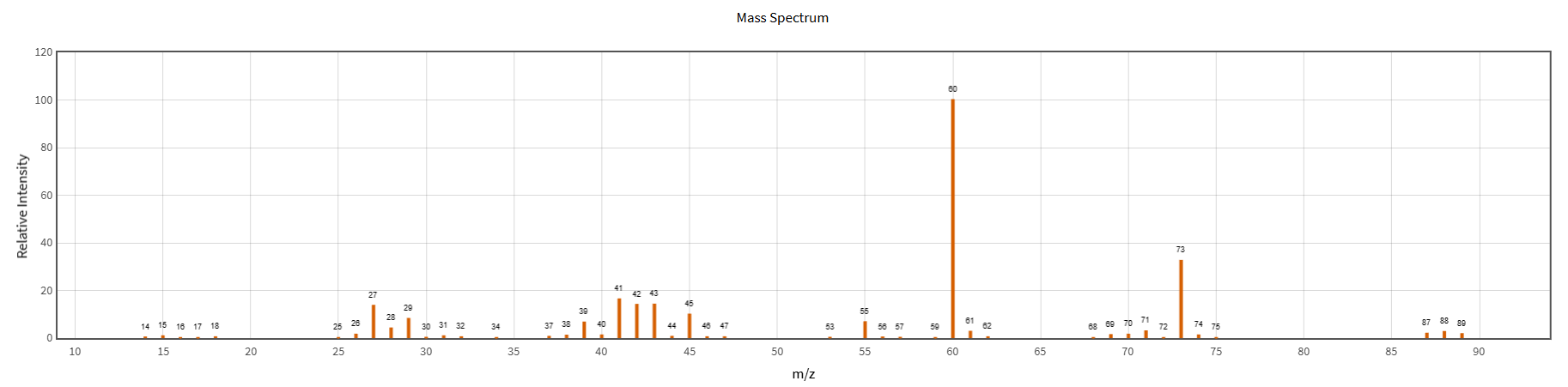
2. EI fragmentation separates the candidates. Reference GC-MS data compiled by PubChem show different dominant fragment patterns. Acetophenone has prominent ions at m/z 105 and 77, with the molecular ion at 120 also visible. Phenylacetaldehyde includes prominent ions at m/z 43 and 91. A compatible library spectrum can therefore rank one candidate strongly above the other. The analyst must still compare acquisition conditions and check for co-elution.
3. ¹H NMR gives the decisive connectivity clue. Acetophenone reference data show a three-proton singlet around 2.58 ppm, consistent with COCH₃, and no aldehydic proton. Its ¹³C spectrum includes the carbonyl near 197.85 ppm (PubChem spectral data). By contrast, published characterization of phenylacetaldehyde reports an aldehydic proton at 9.74 ppm coupled to a two-proton signal at 3.68 ppm, consistent with CH₂CHO (supporting information for DOI 10.1039/D1SC00700A).
4. The evidence is combined, not voted on. MS establishes that the formula and fragmentation match the proposed candidate. NMR establishes whether the side chain contains COCH₃ or CH₂CHO. If the result supports a high-consequence decision, an authentic standard analyzed under the same method can confirm retention and spectral agreement. The conclusion is stronger because each technique resolves a different ambiguity.
A combined workflow should pass constraints forward rather than repeat the whole analysis on both instruments.
This is the logic behind hybrid MS/NMR strategies for unknown metabolites. Published workflows combine molecular formulas from high-resolution MS with NMR constraints and computational candidate generation, reducing the need for exhaustive purification while still requiring experimental validation (Bingol, 2019).
Automation is most useful after the analytical question and evidence boundaries are clear. Candidate-generation software can use a molecular formula, NMR correlations, predicted shifts, or MS fragments to reduce the search space. Bruker’s current CMC-se workflow, for example, starts from a molecular formula, interprets 1D and 2D NMR data, and can incorporate MS fragmentation as additional information. The output remains a set of proposed structures for the chemist to evaluate.
Spectra is Rombo AI’s AI agent for NMR analysis, distinct from Rombo AI Platform. Its current public workflow accepts an NMR spectrum, highlights discriminating patterns, and returns ranked candidate structures with confidence scores; the chemist remains responsible for assignment and validation (Rombo compound-identification workflow). MS results can still constrain the formula and candidate list before that NMR review, but they should not be described as a confirmed Spectra input unless the product documentation explicitly supports it.
If manual NMR candidate review is the bottleneck in your compound-identification workflow, open Spectra to evaluate the NMR-first workflow on an appropriate spectrum. Treat the ranked result as the next analytical step, then confirm it with the orthogonal evidence your application requires.
Neither is universally better. MS is usually the better first choice for trace detection, rapid screening, and complex mixtures, while NMR is stronger for connectivity, isomer discrimination, and structural context when enough sample is available.
MS can provide formula, isotope, and fragmentation constraints, and some compounds produce highly diagnostic spectra. Constitutional isomers and stereoisomers can remain ambiguous, so a complete assignment may require NMR, chromatography, an authentic standard, or another orthogonal method.
The answer depends on nucleus, field strength, probe, experiment, molecular weight, solvent, and required signal-to-noise. MS generally detects much lower amounts, while multidimensional NMR often needs more material; laboratories should determine feasibility from instrument-specific detection limits rather than a universal sample-mass rule.
Start with MS when sample is scarce or the formula is unknown. For an isolated compound with sufficient material, accurate-mass MS followed by a targeted NMR experiment set is often the most efficient sequence.
A library match supports a candidate only within the reference coverage and measurement conditions. Confirmation requires the evidence level defined by the laboratory, which may include retention agreement, orthogonal spectra, and analysis of an authentic standard under the same conditions.
Posted by: Martina [Marketing Specialist, Rombo AI]
BOOK A DEMO
Share your analytical challenge with our team. We will assess technical fit, data or sample requirements, and the fastest path to a focused pilot.
Book a demo